Beyond Tuition Revenue: The Economic Contribution of International Students to Finland's Higher Education System (2024-2025)
International Education: An Investment in National Growth
The internationalisation of higher education has evolved far beyond academic exchange and cultural diplomacy. Today, it is a strategic driver of economic growth, innovation, workforce development, and global competitiveness.
While countries such as the United States, the United Kingdom, Canada, and Australia have long recognised international education as a major export industry, Finland is rapidly emerging as one of Europe's most attractive destinations for international students. Its reputation for high-quality education, innovation-driven economy, safety, sustainability, and student-centred learning continues to attract increasing numbers of applicants from around the world.
Based on official data from Studyinfo Finland (Opintopolku), the Finnish National Agency for Education (EDUFI), the Finnish Immigration Service (Migri), universities, and other publicly available sources, this analysis estimates the direct economic contribution of international degree students admitted during the 2024 and 2025 admission cycles.
The findings suggest that international students generated an estimated €785 million to €940 million in direct economic value over two years through application fees, tuition fees, residence permit fees, and mandatory living funds. When broader economic effects such as taxation, consumption, employment, entrepreneurship, tourism, and innovation are considered, the overall contribution is likely to be substantially higher.
Growing Global Demand for Finnish Higher Education
Finland continues to experience significant growth in international student demand.
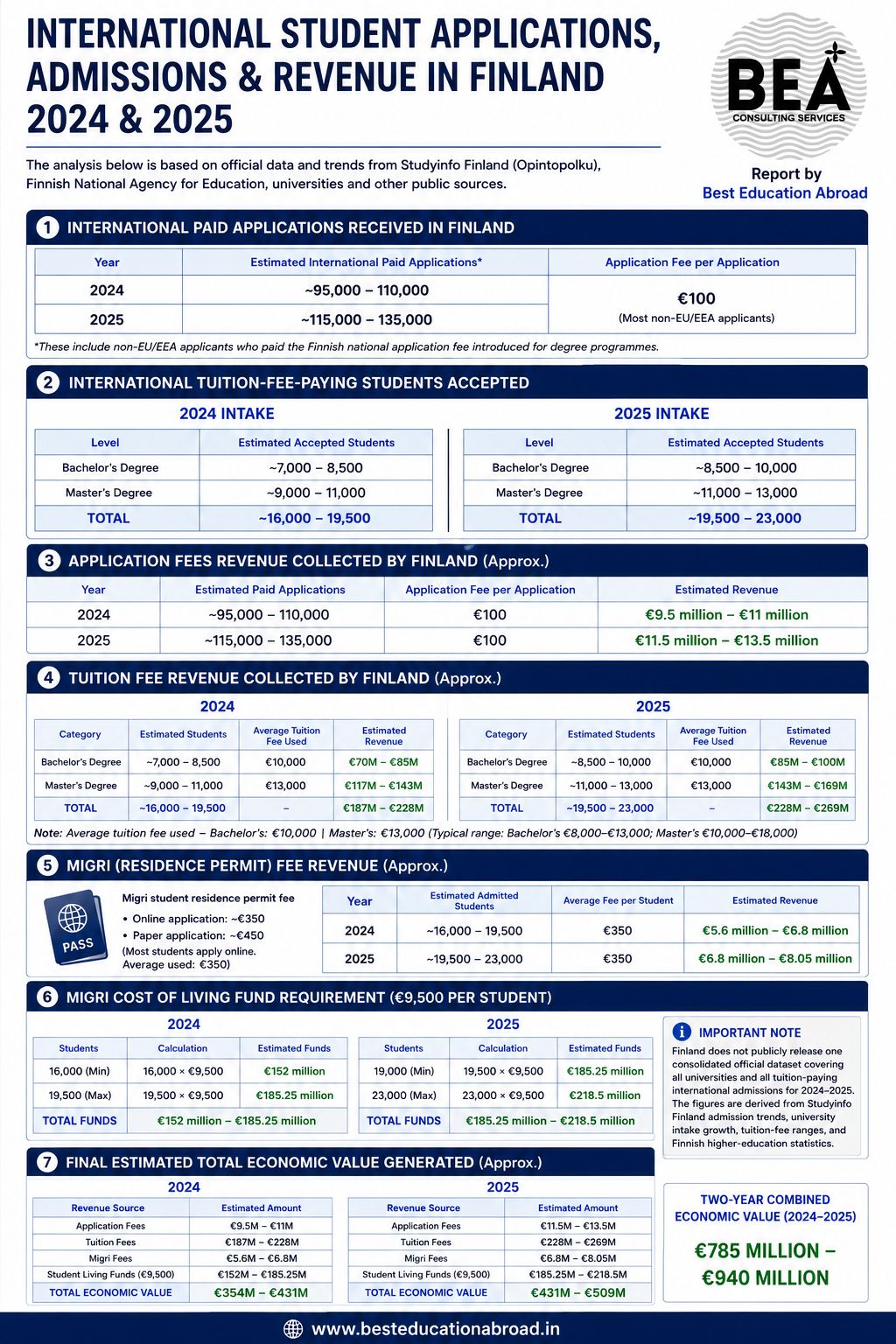
Estimated paid applications increased from approximately 95,000-110,000 in 2024 to 115,000-135,000 in 2025, representing an annual increase of roughly 20-25 percent.
The introduction of the €100 national application fee for most non-EU/EEA applicants has not reduced demand. Instead, it appears to have improved application quality by discouraging speculative applications while maintaining strong interest from serious applicants.
Admissions have also increased significantly. The estimated number of tuition-fee-paying international students admitted rose from 16,000-19,500 in 2024 to 19,500-23,000 in 2025. Master's programmes continue to account for the largest share of enrolments, reflecting Finland's growing reputation in engineering, business, technology, sustainability, health sciences, and applied research.
The Direct Economic Contribution
International students contribute to Finland's economy through multiple channels, extending well beyond tuition payments.
Application Fees
The national application fee generated an estimated:
2024: €9.5-11 million
2025: €11.5-13.5 million
This revenue supports the administration and quality assurance of the admissions process while helping universities manage increasing application volumes.
Tuition Fee Revenue
Tuition fees remain the largest direct financial contribution.
Estimated tuition revenue reached:
2024: €187-228 million
2025: €228-269 million
Over the two-year period, tuition fees alone contributed approximately €415-497 million, reinforcing international education as a significant higher education export.
Residence Permit Fees
Student residence permit applications generated additional public revenue estimated at:
2024: €5.6-6.8 million
2025: €6.8-8.05 million
Mandatory Living Funds
International students are also required to demonstrate sufficient financial resources before receiving residence permits.
Estimated minimum living funds amounted to:
2024: €152-185 million
2025: €185-219 million
These funds are subsequently spent within Finland on accommodation, food, transportation, healthcare, telecommunications, insurance, retail, banking, and other local services, supporting businesses and regional economies.
An Estimated €785-940 Million in Direct Economic Value
Combining these revenue streams, the estimated direct economic contribution reached:
2024: €354-431 million
2025: €431-509 million
Combined Economic Contribution (2024-2025): €785-940 million
These estimates remain intentionally conservative. They do not include:
Student employment and income tax contributions
Value Added Tax (VAT) generated through spending
Graduate entrepreneurship
Research and innovation outputs
Start-up creation
Family visits and tourism
Long-term skilled migration
Local economic multiplier effects
When these broader impacts are considered, the overall economic value of international education to Finland is likely to exceed €1 billion over the two-year period.
Beyond Revenue: Building Finland's Future
The importance of international students extends well beyond financial returns.
They strengthen Finland's capacity by contributing to:
Skilled workforce development
Research and innovation
Entrepreneurship and start-up ecosystems
International collaboration
Export competitiveness
Demographic sustainability
Global academic reputation
As Finland continues to address labour shortages and demographic challenges, attracting and retaining highly skilled international graduates will become increasingly important for long-term economic resilience.
International education should therefore be viewed as a strategic national investment rather than simply a source of institutional income.
Implications for Universities
Growing international demand presents both opportunities and responsibilities.
Universities should continue investing in:
Efficient digital admissions systems
Student support and wellbeing
Career development and employability
Industry partnerships
Alumni engagement
International branding
Graduate integration into the Finnish labour market
Long-term competitiveness will increasingly depend not only on attracting students but also on delivering exceptional student experiences and successful career outcomes.
Implications for National Policy
Maintaining Finland's competitive position requires continued policy development in several areas.
Key priorities include:
Streamlining residence permit processes while maintaining quality standards.
Expanding post-study employment opportunities.
Strengthening collaboration between employers and international graduates.
Simplifying pathways from graduation to long-term employment and residence.
Developing targeted recruitment strategies in high-growth markets, particularly India, Vietnam, Nigeria, Indonesia, and Latin America.
Such measures will help Finland maximise both the educational and economic returns of internationalisation.
India: A Strategic Partner for Finland
India has emerged as one of Finland's fastest-growing source countries for international students.
Its large youth population, expanding middle class, strong interest in STEM education, and increasing demand for high-quality international qualifications position India as a key long-term partner for Finnish higher education.
However, sustainable growth requires more than recruitment campaigns.
Finnish institutions should strengthen their presence through long-term partnerships with schools, universities, industry, alumni networks, and trusted in-country representatives. Building institutional relationships and supporting students throughout their educational journey will be more effective than relying solely on transactional recruitment models.
Conclusion
International education has become one of Finland's most valuable strategic assets.
The estimated €785-940 million generated during the 2024 and 2025 admission cycles demonstrates that international students contribute far more than tuition revenue. They support economic growth, innovation, research, entrepreneurship, workforce development, and Finland's long-term global competitiveness.
As global competition for international talent continues to intensify, Finland has an opportunity to strengthen its position by adopting a holistic internationalisation strategy that integrates recruitment, student success, graduate employability, and talent retention.
The future success of Finnish higher education will not simply be measured by the number of students it attracts, but by the long-term value those students create for universities, industry, communities, and society.
References
Finnish National Agency for Education (EDUFI). Studyinfo Finland (Opintopolku).
Finnish Immigration Service (Migri). Residence Permit Statistics.
Ministry of Education and Culture, Finland.
OECD. Education at a Glance.
OECD. International Migration Outlook.
UNESCO Institute for Statistics.
Altbach, P. G., & Knight, J. (2007). The Internationalization of Higher Education: Motivations and Realities.
Knight, J. (2004). Internationalization Remodeled: Definition, Approaches and Rationales.
de Wit, H. (2020). Internationalization of Higher Education: The Need for a More Ethical and Inclusive Approach.
 16 Jun 2026
 09 Jun 2026
 03 Jun 2026
 03 Oct 2025
 03 Oct 2025
 03 Oct 2025
 04 Oct 2025
 03 Oct 2025