
INDIA'S 40% QUALITY GAP IN DAIRY: A USD 50+ BILLION OPPORTUNITY FOR INTERNATIONAL DAIRY COMPANIES (2026)
Executive Summary
The infographic correctly identifies one of the largest untapped opportunities in the global dairy industry: India does not have a milk production gap; it has a quality dairy gap.
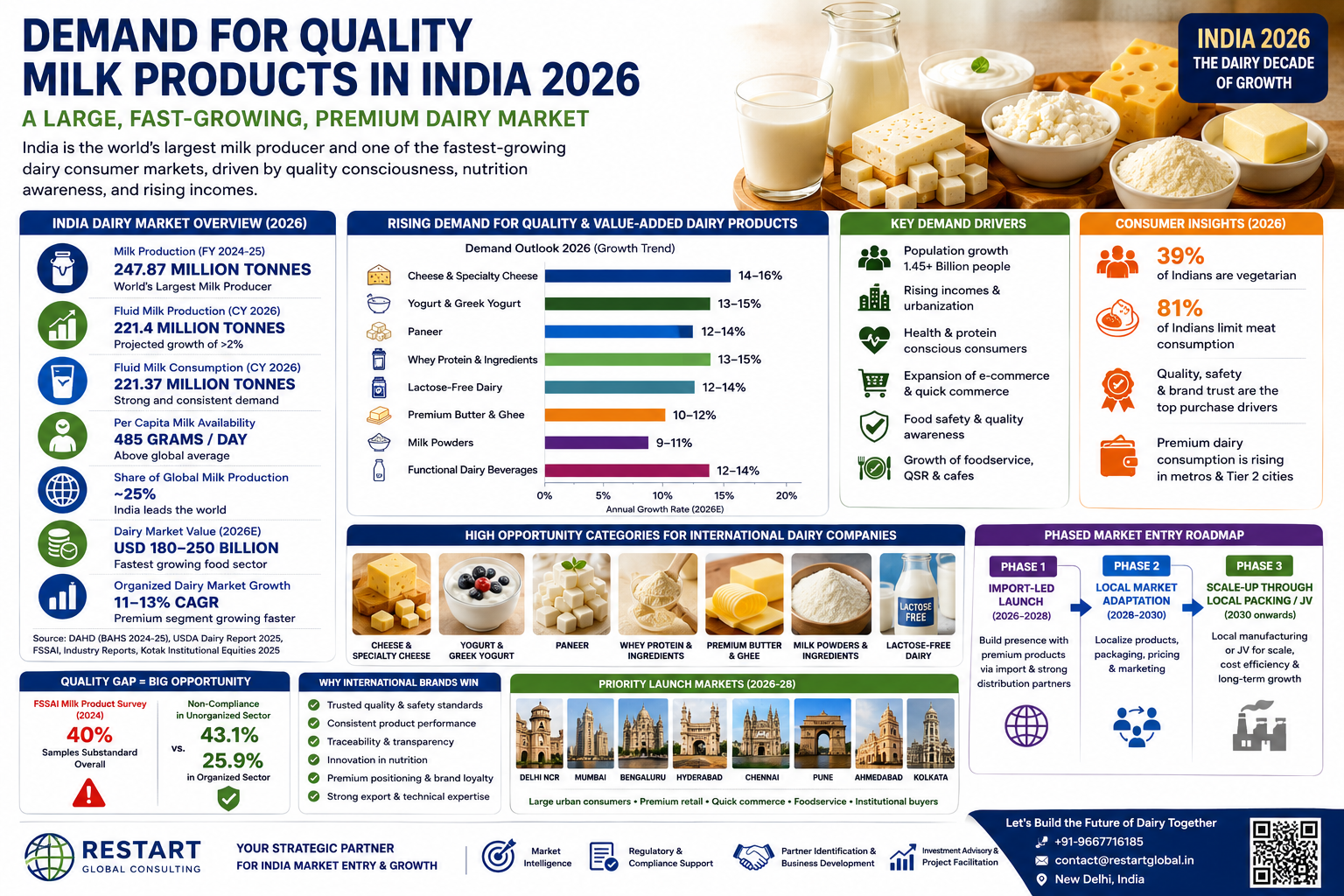
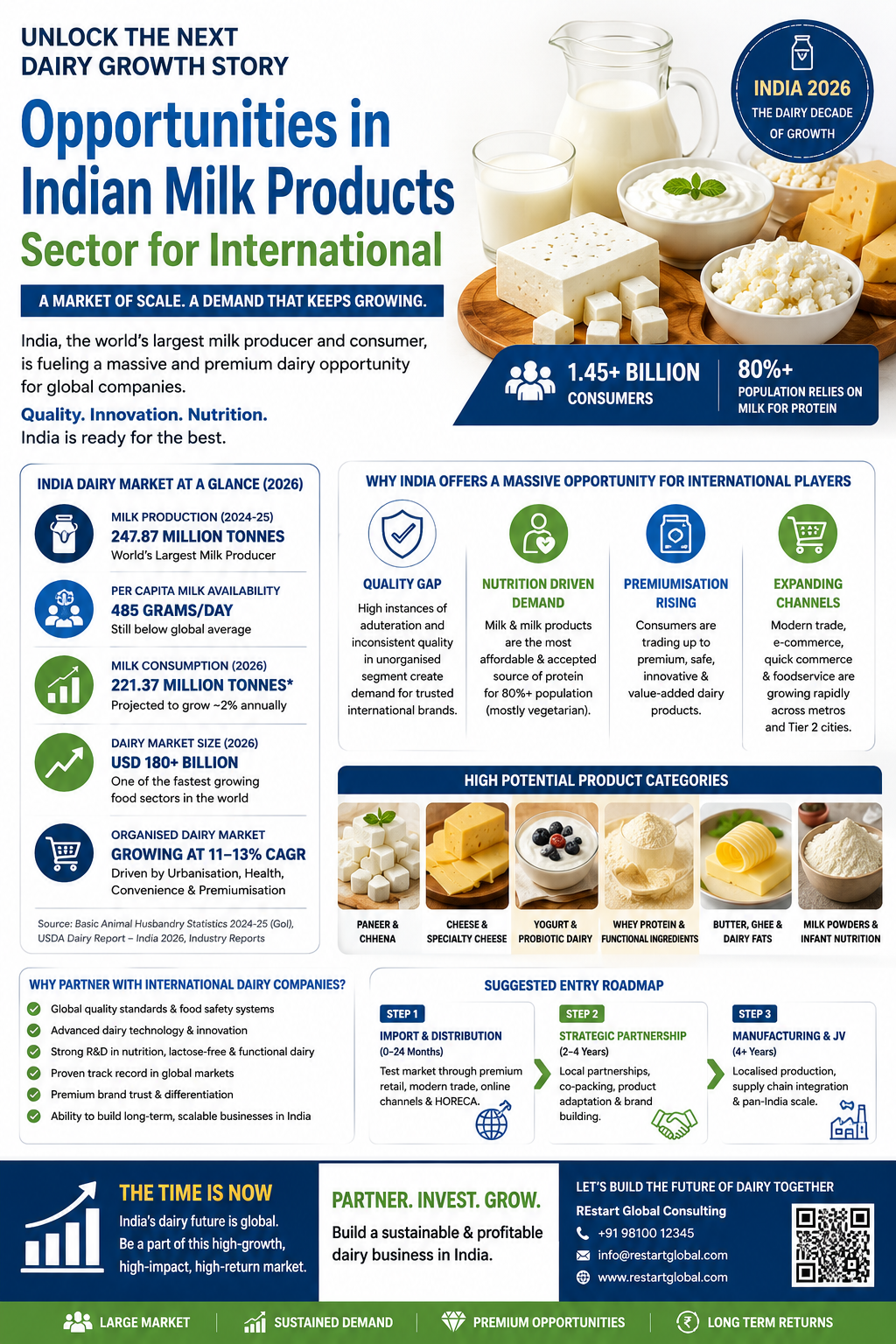
India produced 247.87 million tonnes of milk in FY 2024-25, making it the world's largest milk producer, with per-capita milk availability of 485 grams/day. Yet a significant proportion of milk and dairy products still fail to consistently meet premium quality, traceability, standardization, and international food safety benchmarks.
The infographic highlights:
40% of milk product samples were classified as substandard in the FSSAI Milk Product Survey (2024).
For international dairy companies, this should not be presented as a crisis, but as a market transformation opportunity worth USD 50-100 billion over the next decade.
Analysis of the 40% Quality Gap
What the 40% Figure Represents
The infographic states:
Category | Result |
|---|---|
FSSAI Milk Product Survey (2024) | 40% Samples Substandard |
Unorganized Sector Non-Compliance | 43.1% |
Organized Sector Non-Compliance | 25.9% |
The key message is not that 40% of India's milk is unsafe.
Rather, it indicates a substantial proportion of dairy products do not consistently comply with quality parameters such as:
Fat content
SNF (Solids-Not-Fat)
Product standardization
Label compliance
Processing standards
Cold-chain management
Traceability systems
International export standards
FSSAI continues to maintain nationwide milk surveillance programmes to monitor adulteration and quality compliance across the country.
Quantifying the Opportunity
India's Dairy Production Scale
Indicator | 2026 |
|---|---|
Milk Production | 247.87 Million Tonnes |
Global Share | ~25% |
Per Capita Availability | 485 gm/day |
Dairy Market Value | USD 180-250 Billion |
Organized Market Growth | 11-13% CAGR |
Translating the 40% Gap
If even 40% of the milk ecosystem lacks premium-quality processing and standardization:
Metric | Estimate |
|---|---|
Total Milk Production | 247.87 MT |
Quality Gap | ~99 MT |
Addressable Premium Opportunity | 90-100 MT |
Potential Value Creation | USD 50-100 Billion |
This is larger than the entire dairy market of many European countries.
Why the Gap Exists
1. Fragmented Supply Chain
India's dairy sector consists of millions of smallholder farmers.
Challenges include:
Small herd sizes
Limited mechanization
Inconsistent chilling facilities
Variable milk quality
2. Large Unorganized Sector
The infographic correctly identifies significantly higher non-compliance in the unorganized sector.
This creates opportunities for:
Modern processing
Collection centers
Testing laboratories
Digital traceability
3. Cold Chain Deficiencies
Many rural collection points still lack:
Bulk milk coolers
Temperature monitoring
Automated testing
4. Low Value Addition
A large share of milk is sold as fluid milk rather than being converted into:
Cheese
Whey Protein
Lactose-free dairy
Functional dairy beverages
Sports nutrition
Why International Companies Are Best Positioned
The infographic correctly highlights several advantages:
Proven Quality Systems
International dairy companies bring:
✓ HACCP
✓ ISO 22000
✓ BRCGS
✓ EU dairy standards
✓ Full traceability
Advanced Processing
Experience in:
Cheese production
Whey processing
Infant nutrition
Functional foods
Sports nutrition
Consumer Trust
Indian consumers increasingly associate international dairy brands with:
Food safety
Consistency
Premium nutrition
This trend is accelerating among middle-class urban consumers.
Fastest Growing Categories (2026-2030)
Based on the infographic and market trends:
Highest-growth dairy categories in India
Projected annual growth rates from the infographic.
0%4%8%12%16%Cheese & Specialt...Yogurt & Greek Yo...Whey ProteinFunctional Dairy...PaneerLactose-Free DairyPremium Butter &...Milk Powders
Highest Potential Segments
Cheese & Specialty Cheese
Greek Yogurt
Whey Protein Ingredients
Lactose-Free Dairy
Functional Dairy Beverages
Premium Butter & Ghee
These segments command significantly higher margins than liquid milk.
Recommended Market Entry Strategy for International Companies
Phase 1: Import & Premium Brand Launch (2026-2028)
Focus Markets:
Delhi NCR
Mumbai
Bengaluru
Hyderabad
Chennai
Pune
Actions:
Import premium products
Build distributor network
Establish quality positioning
Phase 2: Local Adaptation (2028-2030)
Actions:
Local packaging
Indian flavor innovation
Regional sourcing partnerships
Institutional sales
Phase 3: Local Manufacturing & Joint Ventures (2030+)
Actions:
Processing plants
Cheese factories
Whey manufacturing
Farmer integration programs
Investment Recommendations
Priority Investment Areas
Area | Opportunity |
|---|---|
Milk Collection Centers | Very High |
Bulk Milk Cooling Infrastructure | Very High |
Premium Dairy Processing | Very High |
Cheese Manufacturing | Very High |
Whey Protein Plants | Extremely High |
Lactose-Free Products | High |
Dairy Traceability Software | High |
Dairy Testing Laboratories | High |
Key Message for International Dairy Companies
India's dairy story is entering a new phase.
The first phase (1990-2025) was about increasing milk production.
The second phase (2026-2040) will be about improving milk quality, value addition, food safety, and premiumization.
With nearly 248 million tonnes of milk production, a rapidly growing middle class, increasing health consciousness, and an estimated 40% quality and standardization gap, India represents one of the largest dairy investment opportunities globally. Companies that bring technology, traceability, premium processing, and value-added dairy expertise will be positioned to capture a significant share of a market expected to exceed USD 250 billion in value.
Strategic Conclusion
India does not need more milk. India needs better milk, better processing, and better dairy products.
That 40% quality gap is not a weakness. It is the largest growth opportunity in the global dairy industry.
To expand your business to India: Get in touch with Restart Global Consulting, New Delhi, contact@restartglobal.in
 16 Jun 2026
 09 Jun 2026
 03 Jun 2026
 03 Oct 2025
 03 Oct 2025
 03 Oct 2025
 04 Oct 2025
 03 Oct 2025