
India Dairy Opportunity 2026
India Dairy Opportunity 2026
A Market-Entry and Growth Proposal for International Milk Production Companies
Prepared by: Restart Global Consulting
Target audience: International dairy investors, including Valio and other global milk and dairy producers
Executive Summary
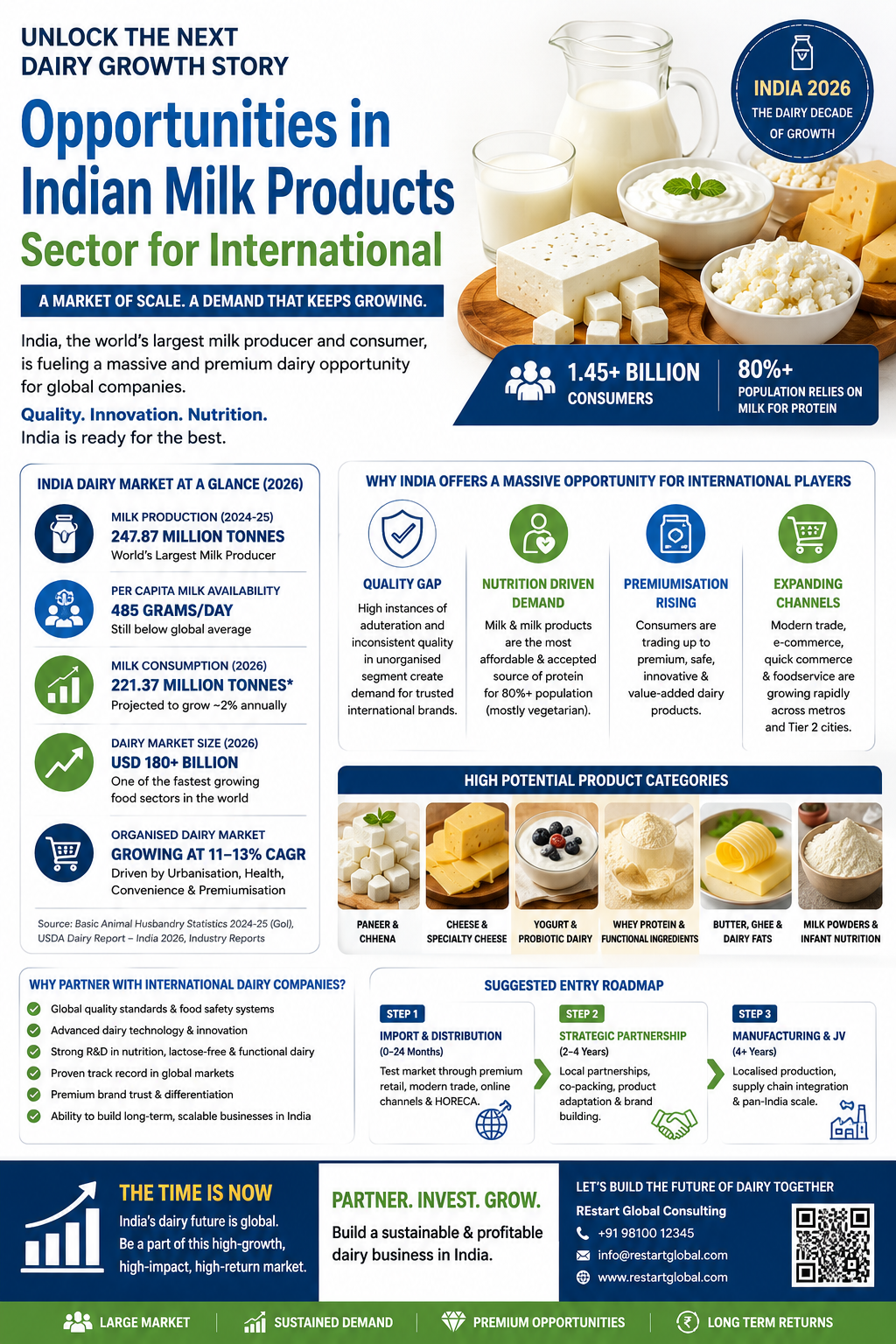
India in 2026 should not be viewed only as a raw milk volume market. It is a very large dairy economy with a rising need for trusted, premium, specialized, and consistently safe milk products, especially in urban and high-income channels. Government data shows that India produced 247.87 million tonnes of milk in 2024-25, and per-capita availability reached 485 grams per day. India remains the world’s largest milk producer. At the same time, USDA forecasts India’s fluid milk consumption at 221.37 million metric tonnes in CY 2026, with growth supported by population expansion, rising disposable incomes, value-added dairy demand, and wider access through e-commerce and quick commerce.
For international dairy companies, the strongest opportunity is not bulk milk alone. The most attractive entry categories in India are paneer, cheese, yogurt, butter, milk powders, whey ingredients, lactose-free products, and premium dairy solutions. FSSAI’s milk product survey also shows that quality and compliance remain important issues in the market, with 40% of samples found substandard overall and higher non-compliance in the unorganized segment than the organized segment. That makes trusted international brands commercially relevant in India’s premium dairy space.
Why India is a compelling 2026 dairy market
India’s consumer base is exceptionally large and dairy-led. Pew Research found that 39% of Indian adults identify as vegetarian, while 81% limit meat consumption in some form. In a country of roughly 1.45 billion people, dairy remains central to daily nutrition for a very large part of the population, especially where milk, paneer, curd, cheese, and yogurt are preferred protein sources. This is a major demand foundation for premium and value-added dairy products.
The real commercial opportunity is therefore not only about increasing milk supply. It is about supplying quality, consistency, traceability, food safety, and convenience in categories that Indian consumers already buy regularly. That is where premium international brands can win share and build loyalty.
The 2026 demand-supply story
India’s domestic milk production is strong and still growing, but organized demand for premium and specialized dairy is also expanding. USDA’s 2025-26 India dairy outlook says fluid milk consumption is forecast to grow in 2026, butter production and consumption are expected to rise, and SMP consumption is also forecast higher. The report also notes that demand is being supported by growth in value-added dairy products, foodservice, e-commerce, and quick commerce.
At the policy level, India is also working to strengthen formal dairy collection. Under White Revolution 2.0, dairy cooperatives are expected to raise procurement by 50% to reach 1,007 lakh kg per day by 2028-29. That tells us the formal dairy system is expanding, but it also leaves room for premium imported brands and specialized dairy solutions that are still under-served in the market.
Where the opportunity lies for international companies
The most attractive entry point is not bulk fluid milk first. The best ROI categories are premium and value-added dairy products that meet quality, nutrition, and convenience needs in metro and emerging urban markets. FSSAI’s food-import and product framework clearly covers dairy categories such as milk and buttermilk, fermented milk products, paneer/chhena, cheese, butter, and related dairy items, which makes product mapping and licensing more practical for market entry.
The strongest 2026 categories are: paneer, processed cheese, mozzarella, cream cheese, high-protein yogurt, Greek-style yogurt, butter, ghee, milk powders, whey protein ingredients, and lactose-free dairy. These products align well with India’s vegetarian and meat-restricting consumer base and allow international companies to charge a premium for safety, consistency, and innovation.
Why international dairy companies can win
International dairy companies have three strong advantages in India: brand trust, product consistency, and technical capability. Valio is a strong example because it is Finland’s biggest food exporter and says it exports to roughly 50 countries, supplying milk and whey powders, butter, cheeses, and snack products to consumers and industry. That export profile fits India’s premium dairy segment very well.
The best launch markets are Delhi NCR, Mumbai, Bengaluru, Hyderabad, Chennai, Pune, Ahmedabad, Kolkata, Noida, Gurugram, Ghaziabad, and Faridabad. These cities combine premium retail, quick commerce, foodservice, hotels, cafés, restaurants, and institutional buyers, which makes them ideal for imported and premium dairy brands. That is an inference based on the scale and channel mix of the market, and it is consistent with USDA’s observation that e-commerce, quick commerce, and value-added dairy are strengthening demand.
Recommended market-entry model
Phase 1: Import-led launch
Start with shelf-stable or premium chilled products such as cheese, butter, milk powders, yogurt, paneer, and ingredient products. Use a licensed Indian importer and launch through premium retail, modern trade, quick commerce, and HORECA channels.
Phase 2: Local market adaptation
Adapt packaging, pricing, portion sizes, and formats for Indian households and foodservice buyers. Use sampling, chef partnerships, and nutrition-led positioning to build trust and trial.
Phase 3: Scale-up through local packing or JV
Once demand is established, move toward local packing, contract manufacturing, or a joint venture to reduce landed cost and improve distribution efficiency.
This phased model is the most practical way to enter India because it lowers initial risk while allowing the company to learn category demand before committing to heavier manufacturing.
Regulatory pathway international companies must follow
Any foreign dairy company entering India needs a proper import and food-compliance structure. DGFT states that an IEC is mandatory for import into India, and FSSAI operates the Food Import Clearance System (FICS) for imported food clearance through Customs integration and risk-based sampling. In practice, this means the company or its Indian partner must secure the correct import code, FSSAI import licensing, labeling compliance, and shipment-level clearance.
How international companies can solve India’s incremental dairy demand
International dairy companies can solve the incremental demand in five practical ways:
First, by supplying premium imported dairy where trusted supply is limited.
Second, by entering the ingredient market for bakeries, confectionery, hotels, cafés, and food manufacturers.
Third, by offering lactose-free and high-protein dairy, which is still underpenetrated relative to demand.
Fourth, by introducing standardized quality and traceability that urban consumers value.
Fifth, by building localized packaging and distribution so products become more affordable and accessible beyond the top end of the market. These are strategic recommendations derived from the market data above.
Conclusion
India in 2026 should be positioned as a premium dairy opportunity market, not a commodity milk market. The demand base is large, the vegetarian and meat-restricting consumer population is massive, the quality gap is real, and the organized premium dairy segment is still under-served. International companies such as Valio can win by entering with premium dairy products, building trust in metro cities, and then scaling through import, packing, and partnership models. That is the route most likely to deliver strong long-term ROI in India’s dairy sector.
 09 Jun 2026
 03 Jun 2026
 03 Oct 2025
 03 Oct 2025
 03 Oct 2025
 04 Oct 2025
 03 Oct 2025